
Published by HarperCollins India, 2021, 304 pages
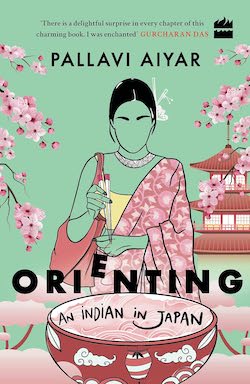
Orienting is Japan seen from the perspective of an Indian journalist. Pallavi Aiyar moves home (and country) every few years: her husband works for the European Union, and they have lived in nine countries, including China and Indonesia.
She finds Japan quite unlike China or Indonesia. “It was rich and quiet, old and punctual, a former colonizer rather than colony, rule-obsessed rather than loop-hole hungry”, and “a desire for simplicity with the tendency to complicate”. Take the language, for example.
For someone who speaks Mandarin and Bahasa Indonesia, the language defeats her. I found the chapter on Japanese fascinating (and could understand why it was so difficult for her). Japanese has two alphabets with 46 letters each: hiranga and katakana. They are identical; katakana’s only purpose is to indicate words of foreign origin. And that was just one of the complications. Even the basic words were complex: the word “one”, for example, differed depending on what it described: one cat, one umbrella, etc.
But Aiyar finds plenty to love about Japan, such as haiku, the Japanese short verse form that captures a moment in time. There are several scattered in the book, which I enjoyed as a lover of haiku. She also loves the quiet of monasteries, and kintsugi, the art of repairing broken pottery with powdered gold lacquer, which highlights imperfections instead of hiding them. She throws herself into life in Japan (as much as you can with two children), going for classes on the tea ceremony and Japanese drumming.
The book is full of interesting facts. Japan is one of the safest places to be: there is a strong sense of community and responsibility. Children as young as six go to school on their own. If they get lost, all they have to do is go to the nearest kombini (convenience store) to call their parents. There is very little theft. Aiyar recounts an incident about losing her wallet. She reported it to the police, who found that it had been handed in to a nearby police station—untouched, all the money and cards still there. She comes to the conclusion that trust breeds trust—if someone handed in your lost items, you were more likely to do the same yourself.
Japan is a fairly homogenous country that is beginning to open its doors to foreigners by easing the restrictions on visas for blue-collar workers. This is a question of necessity: the population is falling and the country needs workers. Aiyar visits Yogendra Puranik, a Japanese politician who was born in Mumbai, the first Indian-born Japanese politician. Puranik was elected not by the Indian diaspora but by the Japanese.
This is an extremely enjoyable book—seeing Japan through the eyes of an Asian woman who comes from a fairly different culture (Aiyar has something to say about the difference between India and Japan, and why the two find it so hard to work together). As a journalist, her observations are astute, and she does not gloss over Japan’s problems, such as the high suicide rate among workers, and the pressure to conform. But she also develops a great affection for the country and its people.
At the end, she says, “The book was ultimately probably as much about me as observer, my circumstances and predilections, as it was about Japan.” But I think she does herself an injustice. Although you can never truly know a place completely, living there for four years—with a healthy dose of curiosity and open-mindedness—means that you do go deeper than the surface. This a book that I would recommend.
This review first appeared on Women on the Road.


Leave a Reply