
Published by Bloomsbury Wildlife, 2021, 320 pages
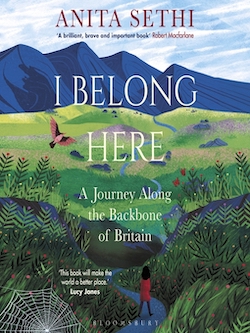
“Get back on the banana boat!” On a train from Liverpool to Newcastle, Anita Sethi is subjected to a vicious attack by a man, who lets loose a torrent of abuse. But she is British, born in Manchester and as much a part of the country as he is. The incident leaves her with post-traumatic stress disorder—this was not the first time—and she suffers from anxiety, panic attacks and claustrophobia.
Craving wide open spaces, Sethi decides to reclaim her country by walking its “backbone”: the Pennine Way, at 431 kilometres the UK’s oldest trail. The Way follows the Pennines, a range of hills and mountains that run from the Peak District to the Tyne Gap. She is determined to transform the incident of hate into something that brings hope and beauty.
“Dehumanising language is designed to cause despair, but I will not leave the pathways I walk upon, this place I call home. I will not give in to fear and despair. Instead, I walk even further, even deeper, into this place where I belong.”
She sets out with the basic equipment she has, which results in water seeping in through her boots. But as she walks, she starts to get stronger and heal mentally as well. The landscape helps her put her problems into perspective: “I relish even the moody and mercurial clouds threatening rain at any moment, for so vast are they that they add to the sense of the great outdoors’ immensity, making me feel tiny in the landscape, my worries washing away.”
Her descriptions of natural beauty around her are vivid, like the path behind her, “weaving its way like a strand of silver hair in the mountains and then vanishing into the mist”. She connects with some of the people she meets, learning to trust again.
This is much more than a travel book. Sethi writes about her journey, both physical and emotional—a “journey is not just linear but takes us inward”, she says. She also tackles the bigger issues: for example, the “banana boat” the racist referred to leads her to talk about the banana plantations and the indentured labourers brought to work on them.
This is a rich book, and I loved the way Sethi found intimate connections between the landscape and humans—not just in the way we relate to the land, but also drawing on deeper connections through language. Visiting Hull Pot, the largest natural hole in England, she draws a parallel with the holes left in our lives by grief and loss, like the death of Sethi’s friend, to whom the book is dedicated.
“I sit down a while and gaze at the landscape and breathe. I knew that journeying through the North had something to offer up to me. I felt it calling me. Go back to where you’re from. This is where I’m from. I’m from the North. The glorious North.”
This is ultimately a story about healing, identity, and a sense of belonging.
This review first appeared on Women on the Road.


Leave a Reply