
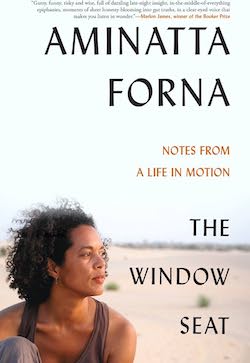
Published by Black Cat, 2021, 272 pages
“Here are four words you rarely hear these days: I love to fly.”
Travel has been an intrinsic part of Scottish-Sierra Leonean writer Aminatta Forna’s life. She spent part of her childhood in Sierra Leone but after her father was arrested and eventually killed by the regime, she moved with her Scottish mother to the UK. Her mother later remarried, and her New Zealander stepfather’s work with the United Nations took him to Iran, Nigeria and Zambia, places that Forna visited for her school holidays. So she grew up as a citizen of the world.
The Window Seat is a collection of pieces that are a mix of travel writing, memoir, and essays. She keeps coming back to the meaning of home and what it means for someone like her.
The first essay in the collection, from where the quote above is taken, is a love letter to flying. Forna had a Junior Jet Club logbook, given to children by BOAC (later British Airways) in which you could record your flights. This brought back memories because I had one too.
Curfews were a common occurrence in Forna’s life, whether in Sierra Leone, Nigeria, Zambia, or Iran. She writes about how people try and live a normal life in spite of them, for example, skirting army checkpoints to have a drink at their favourite bar or attending “curfew parties” where you would arrive early and leave before curfew, or arrive just before curfew and stay until dawn.
War is another factor that seeps into some of her essays. She writes about how, if we take long-haul flights regularly, at some point we fly over a war zone. “Consider the matter: people are killing and being killed and living in terror of being killed while, at a point precisely overhead, you are doing what? You are watching the drinks trolley edge down the aisle, handling the frustrations of plastic cutlery and those fiddly salt and pepper packets, selecting the next movie… Imagine a person looking up and seeing an aeroplane in the sky, the freedom the passing plane must surely represent. It must be like standing on a desert island, watching the ships pass by, without the possibility of being able to lift a hand and wave or to shout and be heard.”
War can become a reality so quickly. The war in ex-Yugoslavia spread fast because every man had a gun: it was a nation of hunters. In Sierra Leone, “if you saw a gang of men in the back of a Toyota Hilux carrying machetes, you’d think they were farmworkers… . A few years later, you’d be running for your life.”
This is a rich and varied collection. Forna writes about the Renaissance generation in Africa, the first generation of young African men and women who were sent to the West to study and came back to their countries with new ideas. Her father and Obama’s, as well as many leaders of African countries, were part of this generation.
There are also reminiscences about the people whom she knew or key moments in her life. In a moving piece called Santigi, Forna tells the story of a man who worked in her family’s home from his youth until his death. In Freetown, she meets a veterinarian who looks after the stray dogs in the city. She travels with her mother and brother to Shetland, where she spent part of her childhood, the last trip her mother could make.
This eclectic collection contains so much more—including an examination of insomnia, which Forna suffers from; how wildlife thrives in cities; and what it means to navigate the world as a woman, particularly a woman of colour. The pieces are thoughtful and beautifully written. I know there are ones I will return to over the years.
This review first appeared on Women on the Road.


Leave a comment