
Published by Speaking Tiger, 2024, 214 pages
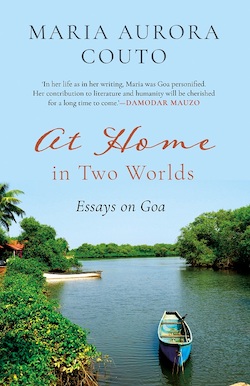
When you think of Goa, what images come to you? Most people associate this tiny state on the west coast of India with beaches, sunshine, good food, a laid-back attitude… in other words, the perfect beach holiday. But there is much more to Goa than the touristic aspect. In this book, Maria Aurora Couto gives us the real Goa—the one where people live—and its history. She was from Goa, as was her husband, Alban, a civil servant.
Before I go any further, I’d like to say that Couto was my lecturer in university, and one of my favourites. She had a way of pointing something out that would change the way you saw things. Unfortunately, I lost touch with her, and although I go regularly to Goa (I have close family there now), she died before my visits.
In this book, Couto’s love of Goa comes through. She takes us through the state’s history, drawing on writing about Goa, including her husband’s. She intersperses this with her own experiences and the people she met, including some key Goans, such as freedom fighters, art historians and lawyers, so you get a picture of its recent history and how it has changed over the years. She also writes about meeting Graham Greene, who was writing about Goa for The Sunday Times, and Umberto Eco, who was there for a conference.
Goa—unlike the rest of India, which was part of the British Raj—was a Portuguese colony. The Portuguese arrived in the early 1500s. In the 18th century, the Marquês de Pombal from the court of King José I introduced a revolutionary law throughout the Portuguese empire: a law of equality without distinction of race, creed or caste. When Portugal became a republic in 1910, Portuguese citizenship was extended to all Goans who had converted to Christianity.
Goa has a rich culture. It has been influenced not only by the Portuguese, but also—going further back in time—the Kadamba, Vijayanagara and Bahmani periods in Indian history. The ancient city of Govapuri was a busy trading centre, so cultures from across the seas were added to the mix.
One of the traditions particular to Goa is gaunkari, an ancient system of land use and community welfare that provides many Goans with a “deep, almost primordial link” with their villages and is also “responsible for Goans’ deep sense of self, rooted in the land and its imagery”. It is a way of managing land and water communally without land ownership. It already existed when the Portuguese arrived. They merely codified its laws and named it comunidade. Couto writes that gaunkari is the best representation of the self-governing villages that flourished in different parts of India.
Unfortunately, after the independence of India and the liberation of Goa in 1961 (as that period is referred to), Goa was not granted special status, which would have protected the gaunkari system. A lot of land was sold to non-Goans, who built second homes there, cutting down old trees and destroying the environment. But the system still exists, and Couto’s husband made sure that their sons were registered in his village.
Couto grew up in South Goa. Her husband Alban had several postings in Goa, including as the state’s first Development Commissioner after liberation. The postings meant living in North Goa, which gave Couto an opportunity to discover this part of the state.
She complains about how Goa and Goans are stereotyped, and their difference has led to “a perception of the Goan as the ‘other’, thereby marginalising the population from the cultural matrix of India”. Goa, as Couto points out, has a vibrant civil society and “issues of identity, language, and culture are contested in the press, in academic circles, on blogs, sites, as well as on the balcāo—the porches of the traditional Goan homes”. On the whole, people of different faiths and communities coexist peacefully, something that cannot always be said of other parts of the country.
I have been to Goa several times, mostly away from touristy areas, and I have grown to love it: the place, the people and the food. But I did not know much about its history, apart from the fact that it was a colony of Portugal. There is so much more to Goa than the average tourist sees. And this book, both historical and very personal, goes a long way in filling in those gaps.


Leave a comment