
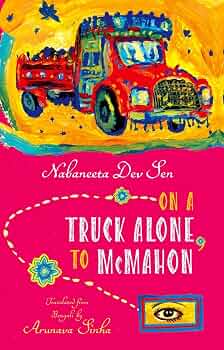
Translated from Bengali by Arunava Sinha
Published by Oxford University Press, 2018, 216 pages. Original version published in 1984.
“I wasn’t trying to discover new places. I wasn’t going to break or create a record. Nor to be useful to anyone. I was going only on an impulse, entirely on my own, just out of the natural curiosity that life brings, the delight of living. Was this not a valid reason?”
This is the account of a trip Nabaneeta Dev Sen took in 1977 through north-eastern India, a trip taken on a sudden impulse.
When Sen travels to Jorhat in Assam to attend a women’s literary conference, it strikes her that she is not so far from Tawang—a town near the McMahon line (the boundary between Tibet and India) and close to the India-China border. There is a Buddhist monastery there has rare Tibetan manuscripts. It’s somewhere she’s never been and wants to go. What’s to stop her?
A few things, actually. For one, there is no public transport to Tawang. It is close to the Chinese border, so she will need a permit. Besides, as worried friends point out, anything could happen to a woman travelling alone. And anyway, why on earth would a respectable, middle-aged Indian woman want to go somewhere so remote? Why can’t she just go see friends in nearby towns instead?
But Sen is determined to get to Tawang, and nothing can stop her. When the ride with a businessman she happens to meet on a boat doesn’t work out, she’s perfectly happy to hitch a ride on a truck carrying rations. “Women can’t travel on the ration truck”, points out a well-meaning officer. “It’s a very rough journey.” Sen, naturally, completely ignores the advice.
One of her travelling companions on the truck is young Dr. Lalwani, trying to get back to his practice. The doctor is a gentle, rather nervous man, completely overwhelmed by Sen. When they get to a small town, the government guest house where they were hoping to stay is full. But there is really is nowhere else for them to go, so Sen announces to the watchman that she will sleep in the living room and insists that the young doctor sleep on the dining table rather than in the truck. This seems to make him nervous, so she assures him her intentions are honourable and rigs up a discreet curtain between them.
When she is not knocking over obstacles in her path and getting exasperated with Dr. Lalwani, Sen finds the time to take in the beauty in her surroundings. She goes out at night for a walk near a waterfall. “The air was redolent with the fragrance of wild flowers. … The mountain stream was flowing far below. … Strange insects swarmed on the leaves, emitting a variety of sounds. Even the noise from the hotel had faded—there was just the sound of the waterfall, and the buzzing of insects. It was all so wonderfully serene.”
In the end, she has a memorable trip. The truck drivers and their companions are friendly and impressed by Sen’s determination. She talks to everyone, and once she gets to Tawang, she spends time in a village with a family from the Mompa community and learns about their way of life. Women and men in this community can take other partners, but the children are always officially the first husband’s and get an equal share in his property. The various husbands and wives live together as a family, working the land and raising the children. Contrary to the practice in the rest of India, it is the Mompa groom’s family that pays a dowry: women work harder than men and are the ones sought after.
This is a thoroughly enjoyable travelogue. Sen is a force of nature with a great sense of humour. When Dr. Lalwani, who has been pushed to his limits by Sen (admittedly, it doesn’t take much), calls her a crazy lady, Sen thinks indignantly, “I am not crazy, and definitely not a lady”. She sounds like the kind of woman I would love to travel with.
This review first appeared on Women on the Road.

 Women's Travel Books
Leave a comment