
Published by Penguin, 2014, 230 pages
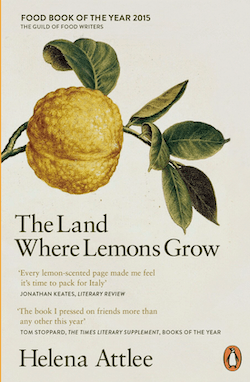
“During journeys that have taken me from the bergamot groves of Calabria, on the southern tip of the Italian peninsula, to lemon houses set against the snowy backdrop of the Alps, I found that citrus trees and their fruit have had a radical part to play in Italy’s political and social history, and have brought extraordinary wealth to some of the poorest places in the country.”
This is a travel book with a difference: at its center is the citrus fruit in its various forms — lemon, orange, bergamot and much more. And what a story it is, intertwined with politics, organized crime, the aristocracy, and brave and determined farmers.
Atlee’s first glimpse of lemon trees was over three decades ago, when her train pulled into the Italian Riviera. “[T]here were lemons growing beside the station platform, their dark leaves and bright fruit set against a backdrop of nothing but sea…”
Atlee’s interest in Italian gardens—she designs garden tours in Italy—led her to ornamental citrus trees grown in pots. But these plants, she found, represented only a small part of Italy’s citrus history.
Until 831 CE, when the Arabs brought lemons and sour oranges (the kind used for marmalade) to Sicily, Europe’s only citrus fruit was the citron, brought to Calabria by the Jews in 70 CE.
Sicily had dry, hot summers and cold, rainy winters, so the Arabs devised irrigation methods to catch and store and redistribute water, methods that are still in use today on some citrus farms.
Growing citrus became profitable when, in the 1700s, it was found that lemons could prevent and cure scurvy, suffered by sailors on long voyages.
Italian lemons became popular in the UK and then in the US, but the large earnings attracted the wrong kind of attention. To profit from the citrus boom, an organization was formed in the lemon groves of the Conca d’Oro in Sicily—an organization made not only “bandits, smugglers and cattle thieves” but also “lawyers, politicians, estate managers and farmers”: the Mafia.
Atlee travels around the country, exploring the stories behind Amalfi lemons, Calabrian bergamots, and Sicilian bitter oranges. (And for foodies, there are recipes scattered throughout.) She writes about bizzaries, the strangely shaped fruit grown by the Medicis in the 15th century, and highlights the extraordinary variety of citrus.
In Liguria, Atlee comes across a perfectly spherical lemon in the citrus grove of farmer Giacomo Parodi, whose trees grow in “lovely fruitful confusion”. “It got too friendly with an orange”, he tells her.
I love books that make you see everyday things in a different light. The Land Where Lemons Grow takes as its subject fruits that we all take for granted and reveals their secret history.
I learned a lot not just about citrus fruits but also about Italy’s history. I would recommend this book: you’ll never look at a lemon or orange the same way again!
This review first appeared on Women on the Road.


Leave a Reply