
Translated from Norwegian by Kari Dickson
Published by Maclehose Press, 2017, 611 pages
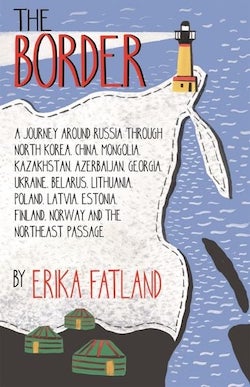
The full subtitle of this book is “A journey around Russia: through North Korea, China, Mongolia, Kazakhstan, Azerbaijan, Georgia, Ukraine, Belarus, Lithuania, Poland, Latvia, Estonia, Finland, Norway and the Northeast Passage”, which gives you an idea of its scope.
What Erika Fatland really wants to know is what it is like to live next to the largest country in the world, but she finds there is no single answer: “There are at least fourteen, as many answers as there are neighboring countries. Though in truth there must be millions of answers, one for each person who lives along the border, each with their own unique history.”
The Russian border is 60,932 kilometers long, longer than the circumference of the earth, which is 40,075 kilometers. Fatland decides to visit the countries along this border, starting in Pyongyang in North Korea, working her way west and north to Grense Jakobselv in Norway, her native country. Then she goes back to Anadyr in northeastern Russia and boards an old Soviet research vessel to cover the 5,650 nautical miles along Russia’s northern coast to Murmansk. Fatland also visits Nagorno-Karabakh, gets close to South Ossetia, and takes a tour of Chernobyl.
Added to the author’s adventures is a hefty dose of history, providing a sense of life today right next to Russia as well as how the borderlands have been shaped by their huge neighbour in the past. Of the fourteen countries she travels through, eight were once part of the Soviet Union.
Fatland speaks Russian, French, English and Norwegian, which makes conversation easier and, as is often the case in a travel book, the people make the book.
In Pyongyang, she is accompanied by guides (always in pairs) who dictate not only the itinerary, but also what can be photographed and what is out of bounds. Sometimes, a curious guide plies her with questions when the other guide is out of earshot.
She visits Heihe, a small provincial town in China on the banks of the Amur River, frequented by Russian tourists who flock over the border to buy cheap Chinese goods. In Mongolia, she meets Tserendavaa, a well-known throat singer, a traditional form of Mongolian singing, who sings for her. In Baku, Azerbaijan, she meets Selcen, a young woman who remembers the war in Nagorno-Karabakh. She fled the war with her parents as a child and moved to Baku.
In Kazakhstan, Fatland makes the complicated trip to Baikonur, hoping to see the Soviet space launch facility. But a mistake in her arrival date meant she can’t visit the facility. To distract her, her guide Marat takes her for endless meals, and finally to a bowling alley.
Fatland seeks out people who, like Selcen, lived through historical events: Andrei, a 79-year-old Latvian, who was one of the 42,000 Latvians who were deported to Siberia in the 1940s; and Maia in Belarus, one of the few surviving Jews in a country that counted nearly one million before the Second World War.
It is hard to do justice to a book that is so rich. Fatland hears many stories of displacement and heartbreak: ordinary people suffering for decisions taken by those in power. For me, the book was an eye-opener. Although I do know something about the history of the region, Fatland brings it to life and tells some unforgettable stories, giving a voice to people we have not heard from before.
A version of this review first appeared on Women on the Road.


Leave a comment