
Published by Pantheon Graphic Library, 2017, 288 pages
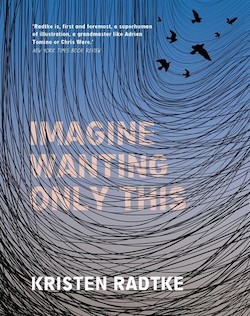
This is not a conventional travel book: it’s a graphic book that combines memoir and travel.
Kristen Radtke is very close to her uncle, Dan, whom she adores. But he has a genetic heart condition, which eventually kills him.
Devastated by Dan’s death, Radtke finds herself losing interest in beautiful places.
She spends time in Italy but is miserable there. Instead, she is drawn towards abandoned towns, places that once hummed with life but have now fallen to ruin.
We follow on her journeys seeking out these ghost towns.
Gary, Indiana, was once known as the city of the century, the center of trade in ore, which was shipped from Minnesota on the Great Lakes railroad. But by the time Radtke visits it, the town has been abandoned. As her then-boyfriend says, “It’s like someone pulled a fire alarm and no one ever came back”. They find a broken-down cathedral where “[i]vy overtook the corroding walls…covering the slated stone with spindles of the earthy web. The tarnished pedals of a shattered organ lay in a corner, its broken keys like piles of pulled teeth.”
In the ruins, they find a bag containing hundreds of photographs, which Radtke takes with her. They turn out to be the work of a young man named Seth Thomas, who was hit by a freight train and killed in 2006. They later discover that the photographs had been placed in the cathedral by his friends as a memorial. Radtke means to take them back but never does.
Radtke travels almost compulsively. Any place is good, as long as it is new. But even in the most beautiful of settings, she seeks out deserted places.
On a trip to Asia with her best friend, they visit the island of Corregidor in the Philippines, a former military base near Manila that developers had tried to turn into a resort. “Guests would have swung in hammocks above fields that had witnessed massacres twenty years before.” The resort never happened, and the island is now a mix of half-constructed buildings and the remains of the military base.
Because of her closeness to death (she has heart disease herself and has also lost other family members to it), Radtke is fascinated with the traces we leave behind. She also writes about her attempts to come to terms with her grief and her acceptance and understanding of the disease.
The book is beautifully drawn in black and white. It does not make for cheerful reading but it is completely original and an important contribution to the travel genre.
This review first appeared on Women on the Road.


 Women's Travel Books
Leave a comment