
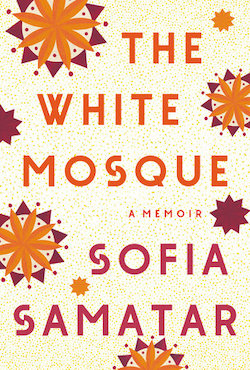
Published by Catapult / C Hurst and Co Publishers, 2022, 336 pages
“I’m haunted by a little piece of history, the story of a small, hardy, stubborn group of people who travelled here more than a hundred years ago.”
In 1880, a group of Mennonites headed east from Russia to Central Asia on what became known as the Great Trek. Being pacifists, they left Russia to avoid conscription and eventually settled in what was then the Khanate of Khiva, situated near the Amu Darya and covering parts of modern-day Uzbekistan, Kazakhstan and Turkmenistan.
They settled in a village called Ak Metchet (White Mosque) because of the white church they built there. But their refuge did not last long. In 1935, the Mennonites refused collectivization and were deported to Siberia.
Almost 150 years later, Sofia Samatar—a Mennonite with an American-Swiss mother and Somali father—retraces their route with a group of Mennonites, some of whom are descended from those who made the trek. In The White Mosque, she intertwines witness accounts of the 1880 journey and her own. As someone of mixed race, she also raises questions around identity and belonging.
The tour group sets off from Tashkent on a bus called The Golden Dragon, accompanied by their Uzbek guides. They move between the past and the present, as they read aloud from published accounts of the trek and search for traces left behind in modern Uzbekistan. Samatar reads about a salamander the size of a cow in one of the witness accounts, and wonders if it was an exaggeration. But it does exist: it is the transcaspian desert monitor, a lizard that can grow up to two feet long.
Samatar’s writing is vivid, and she captures the landscape they drive through: “An open landscape, dun and green, basking in the heat. Mounds of yellow clay piled up where they have been cleaning the canal. The houses are gray brick, with roofs of corrugated iron, sometimes painted, so they make quilt-like squares of lavender, orange, maroon. In the shade of a copse, black sheep clump together, richly colored like handfuls of dates. All movement seems slow compared to the rush of the Golden Dragon: the old men in white caps, chatting together on wobbling bicycles piled with clover; the boy pushing a cart of bottled water; the trotting donkeys.”
This is a rich book, full of human stories and memorable moments. There are stories of brutality on the Great Trek as the Mennonites were not always welcome, and were sometimes driven off by soldiers. But they also found kindness and acceptance. Strangers in villages gave the travellers food and shelter; and a soldier untied a captive Mennonite and covered him with his fur coat.
One of the historic figures that fascinates Samatar is Khudaybergen Dianov, the first Uzbek photographer, who was born in Khorezm, Khiva, in 1878 and was taught his craft by a Mennonite, “an improbable meeting of a boy and a wandering German”. Dianov’s photographs constitute the only photographic record of pre-Soviet Central Asia taken by an indigenous photographer. He joined a dissident movement and was arrested and shot by Stalin’s police in 1938.
One of the most touching incidents is when the tour group arrives in village of Kok Ota. They are welcomed by a group of men who take them to the mosque, in the same way that their ancestors were received when they arrived well over a century ago, hungry and tired. The tour group are invited to pray at the mosque, using it as a church. “[W]ould we welcome Muslim refugees to use our churches, as the Mennonite refugees were invited to use the mosque…to sleep there, worship there, marry there, baptize there?” They meet the descendant of the 19th century imam who opened the mosque to the Mennonites on the Great Trek. Samatar reflects that if the imam’s ancestor had not helped the Mennonites—in effect, saving their lives—some of the members of the tour group might not have existed.
Samatar’s vivid writing feels like she is painting pictures with words. She brings the journeys to life, making you feel a part of the Great Trek. Thanks to this book, I learned not only about the Mennonites and their historic voyage, but also about Central Asia, especially Uzbekistan. The White Mosque is informative and beautifully written, making it a joy to read.
Read the Talking About Interview with Sofia Samatar.
This review first appeared on Women on the Road.


 Women's Travel Books
Leave a comment