
Published by Graywolf Press / Granta Publications, 2020, 416 pages
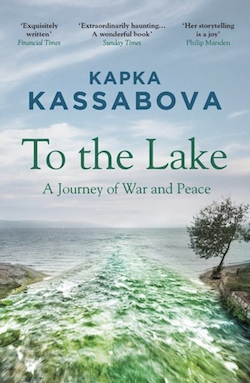
“To journey to the place of your ancestors, you must be prepared to see what it is easier to deny.”
This is the account not just of a physical, but also of an emotional journey. Kapka Kassabova returns to the place her family originally came from, Lake Ohrid on the Balkan peninsula.
She is the fourth generation of women to migrate and is looking not only to learn about her grandmother and great-grandmother but also to understand why it feels like pain—illness, depression, anxiety—is passed on from mother to daughter in her family, “like a dark wave”. “Unless we become aware of how we carry our own legacies, we too may become unwitting agents of destruction.”
Lake Ohrid and its twin lake Prespa straddle North Macedonia, Albania and Greece. The lakes are among the oldest in the world, probably about three million years old and once part of a sea. The lakes are still shrinking; on Lake Ohrid, ladders that once led to the water from hermits’ caves in the surrounding limestone mountains hang halfway down, seeming to go nowhere.
Kassabova starts her journey in Ohrid (“on the hill”), her grandmother’s town, where “all the men look like my cousins” (many of them probably were). The question she is asked is, “Whose are you?”. At dinner in a small restaurant on the first night, she is served by a waiter who is a poet, and the bottle of wine she orders is named after a poem. The place feels magical: “Ohrid made you feel the weight of time, even on a peaceful evening like this, with the screech of cicadas and the shuffle of old women in slippers. Below me was a reminder that gladiators had fought here only two thousand years ago. … The stillness was complete as if the lake absorbed not only noise but time itself.”
She travels along the lake, to rock churches where frescos of saints have their eyes gouged out (probably by people who thought the plaster had magical properties), and visits the shrine of the Black Madonna. She drives to Albania, since she cannot cross the invisible border that cuts through Lake Ohrid, exploring the town of Pogradec on the southern end of the lake.
She will return to Lake Prespa on a second voyage: “I swam in the warm, dark water…but only once—there was an unsettling feeling of something lurking beneath.” But this is also a trip where she finds healing, in the monastery of St. Naum on Lake Ohrid.
The Balkans have a history of conflict, both from invading powers and civil strife. Repressive regimes led to emigration, either because of poverty or politics. Families were split up, including Kassabova’s, unable to reunite because of the political climate.
Kassabova discovers a pattern “of absent men and women left behind, unbending women who dislocated themselves and their loved ones out of shape trying to right what had gone wrong with the family”.
History still has a hold on people. In Albania, the memory of Enver Hoxha’s dictatorship is still fresh. In Greece, Pavle, a Macedonian, tells her about the civil war that tore the country apart after the Second World War. On a more cheerful note, Kassabova visits a cherry orchard near Lake Ohrid which was a gift from a Turkish Aga to his lover, a woman from the family that owns it.
There is also a narrative of religious tolerance. In Ohrid, the azan (call to prayer) is followed half an hour later by church bells, so that they don’t clash. Both Muslims and Christians worship at the same shrines, and there are intermarriages between the faiths.
This is one of the best books I’ve read—not just the best travel book. It is full of history and insight into the Balkan people. Because Kassabova is from the region, there is a sense of immediacy in the stories she tells. The writing is powerful and lyrical, shaded with darkness and light. I’m going to end with a passage about Lake Ohrid. “The land is riven with the anguish and contradictions of linear roads, but the lake contains multitudes. It cannot be imprisoned by chronology. The lake is where all roads end. The boats seem to float on air. I plunged my arms into the lake, forever fresh and green without spring without autumn.
This review first appeared on Women on the Road.


 Women's Travel Books
Leave a comment