
Published by Blackstone Pub / Scribner, 2022, 320 pages
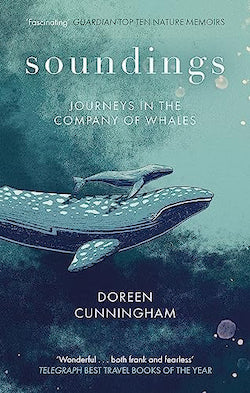
“Then, the whales came. I heard them before I saw them, their breath hissing through the air. Punctuating the silence. The sound was so startling, so alien, it broke the world open. We were no longer the only beings on this spinning sphere of rock. They appeared in the lead, belugas, each breath a triumph of endurance, of stealth, of intelligence, of community, of evolution, of luck. … The mothers huge and white, moving along the lead like ghosts. The babies small grey cogs next to them.”
As a BBC journalist in the mid-2000s, Doreen Cunningham travelled to Utqiagvik, the northernmost town in Alaska, to report on climate change and how it affected indigenous whaling communities. The journey was life-changing. She became part of the Iñupiaq family she stayed with, finding a sense of belonging that she had not felt before. Cunningham’s Iñupiaq family, headed by Julia, make her a part of their lives, even giving her an Iñupiaq name. And this is where she saw the whales—the grey whales.
“Soundings” follows this voyage, as well as one she took in 2013, when her son Max was two years old. She was a single mother, barely employed, just about holding it together. She takes courage from the whales: if a mother whale can make it alone with her young child, why can’t she? So she throws caution to the winds and flies to the West Coast of the US to introduce Max to whales.
This is a fascinating book. The chapters alternate between the two trips, and as you follow Cunningham, you also learn about her life: her childhood with a difficult mother, her fight with her controlling partner for the custody of Max, and her life as a single mother in a women’s refuge (she used up all her savings in the custody battle). She also writes about how initially she had to fight to convince her bosses that climate change was worth writing about.
And through it all, the whales: never far from her thoughts, giving her the courage to carry on.
I found the chapters on her stay in Alaska particularly interesting because they taught me about the way the Iñupiaq live. They hunt whales, but it is done as a community. The hunters are in constant touch with each other, and once a whale is killed, the word goes out and everyone goes home. The whale is cut up and everyone gets their share. They take from the ocean just what they need, no more.
The second trip with Max is quite different. This time, you often see the world through the eyes of a two-year-old, with a sense of wonder. Travelling with a child is not easy, and not everyone appreciates having a toddler around. But Cunningham is determined to find the grey whales, and so is little Max.
This book is a memoir, a travelogue, but most of all, it taught me about whales. These amazing, intelligent giants, who communicate with each other with complex sounds and bury their dead, although “bury” is not really the right word.
“The body, heavily scarred from the battles of life, is borne far, far out before it is let go. The whales dance and dive, down past where the light fades, where the colour gives way to black. In the deep sound layer, they remember him. Voices call in from far around the ocean basin, singing goodbye.”
Cunningham writes with passion and honesty, and it was a pleasure to spend time in her company. She fills the book with information but also with humanity, with the story of her life and the people she loves. This is also a call to do more to stop climate change, not just for the sake of the whales but for the planet.
Read my interview with Doreen Cunningham.
This review first appeared on Women on the Road.


 Women's Travel Books
Leave a comment