
Published by Doubleday, 2018, 272 pages
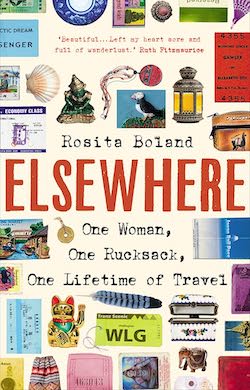
Rosita Boland has a bad case of fernweh, an ache for distant places, a wanderlust which has her leaving her native Ireland to discover the world. “My friend Róisín once asked me why I loved to travel so much. ‘It’s about being elsewhere,’ I found myself saying. It has always been about being elsewhere.”
She begins her book—which covers her travels to a number of countries—by saying she read the entire 13th edition of the Chambers Dictionary, marking obscure words she had never heard of (hence fernweh). As someone who loves words, this got my attention right away. She scatters these words through the book as chapter headings, and I will follow her example by giving every country the word she picked for it.
In Australia (eleutheromania, an intense desire for freedom), she ends up working in Crocodylus, a tiny resort in the middle of a rainforest. Among the guests are a team of footballers, who had obviously been told they were going to a beach resort but were taken to the middle of nowhere. But things brighten up a boar hunt is organized for them.
In England (wunderkramer, a cabinet of curiosities), she goes to pick up a bookshelf from an elderly couple, who tell her they sell things they don’t need so that they can meet people.
In Pakistan (brame, fierce long, passion), she rides a bus up a narrow mountain road, a scary situation made worse by the road being blocked by falling debris. Eventually, a space the width of a wheelbarrow is cleared for the bus to pass. “Everyone fell silent. I have never been on an Asian bus where everyone suddenly stopped talking; in itself, a deeply unsettling sign.” The driver barely manages to get the bus through.
She sails to Antarctica (quiddity, the essence of a thing), which “had become a repository of dreams for all those explorers; a place that nobody owns and everyone can inhabit in their imagination”. Along the way, she and some fellow passengers get on an inflatable boat to get closer to the ice. But the water freezes around them and the boat feels fragile, vulnerable to puncturing by jagged pieces of ice. They are finally rescued four harrowing hours later.
Looking back, she says “I can recall the sensation of life briefly lived in another dimension, a parallel world of unearthly beauty, in time out of time. I recall staring entranced at the blue ice; being colder than I had ever been before; and thrilling freedom of dislocation and freedom, of being so far away from everything and everywhere.”
She takes no photographs but collects “paper ephemera”: bus passes, tickets, receipts, postcards, and so on. These are used on the cover design, and I enjoyed going back to the cover after finishing a chapter to identify the mementos from that country.
Boland not only takes us to the places she went to physically, but we also share her emotional journeys of love and loss. This is a book worth reading, and I am looking forward to reading more from her.
This review first appeared on Women on the Road.

 Women's Travel Books
Leave a comment