
Published by Graywolf Press, 2007, 190 pages
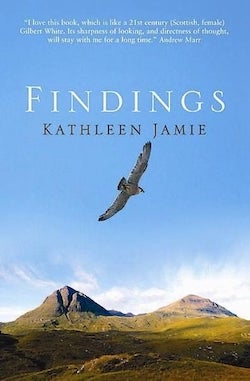
I first read Findings during the Covid pandemic. It was a perfect book at a time when most of us had put our long-distance trips on hold and were instead taking our holidays closer to home. The pandemic had changed the way we lived, taking out the busyness in our lives and leaving time for reflection.
In this quiet, meditative book, Kathleen Jamie writes about Scotland, where she lives, and its natural beauty.
Jamie is fed up with the notion that we need to banish the dark. “We couldn’t see the real dark for the metaphorical dark. Because of the metaphorical dark, the death dark, we were constantly concerned to banish the natural dark.”
So she decides to visit Maes Howe during the winter solstice, hoping to find real darkness. Maes Howe is a Neolithic tomb where 5000 years ago, they interred the bones of the dead.
From the outside, it is just a mound. To enter the tomb, you have to walk, crouching, down a passageway 25 feet long, which opens into a dim soundless stone vault. The walls contain chambers where the bones were laid.
Nearby are the ruins of Skara Brae, a Neolithic village. “There is preserved a huddle of roofless huts, dug half underground into midden and sand dune. There you can marvel at the domestic normality, that late Stone Age people had beds and cupboards and neighbors and beads. You can feel both their presence and their utter absence. It re-calibrates your sense of time.”
The book moves with the seasons, starting in December. Spring brings new life, and Jamie watches the birds return to raise their young. She can see a family of peregrines from her window, and a pair of ospreys nest in a Scottish pine nearby, “a ridiculous toupee made of sticks”.
She goes to the island of Coll to look for the crex-crex (also known as corncrake), a bird that is now extinct in England, where they were once abundant. The brown birds, about 10 inches tall, live in tall grasses and are known for their cry that sounds like “someone grating a nutmeg…[o]r a prisoner working toward his escape with a nailfile”.
On Ceann Iar, an uninhabited island, she watches seals by the sea, undisturbed by the driving rain, and finds not only a dead whale by the beach but plastic detritus and the remains of a small plane. In Braan, she watches the salmon as they try—and often fail—to jump up a waterfall to a spawning place.
But it’s not just nature that intrigues her. She visits the Surgeons’ Hall in Edinburgh, the chapter I found the hardest to read, as she describes the body parts preserved there. She climbs to a vantage point in Edinburgh to look at the city, taking in its skyline and through a telescope, the details of its buildings.
Findings is essentially about seeing your surroundings, noticing the tiny details. But to do that, you need a stillness within, which Jamie has. This book is an inspiration to stop and look at the world on your doorstep.
This review first appeared on Women on the Road.

 Women's Travel Books
Leave a comment