
Translated from Chinese by Jack Hargreaves and Yan Yan
Published by Astra House, 2021, 320 pages
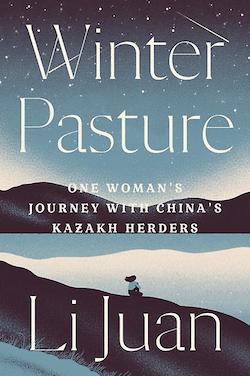
Kazakh herders in China have been practicing their way of life for centuries. With their cattle, camels, sheep, and horses, they move from pasture to pasture, depending on the season.
Li Juan is a 30-year-old writer who lives with her mother in Akehara village near the Altai mountains, which border China, Kazakhstan, Russia, and Mongolia.
To document the herders’ way of life before it disappears, Li arranges to travel with them to the winter pasture. (As it happens, the journey described will probably be the last taken by the herders before they are settled by the government.)
The winter pasture is not a particular place: it is “all the land used by the nomads during the winter, stretching south uninterrupted from the vast rocky desert south of the Ulungur River all the way to the northern desert boundary of the Heavenly Mountains (also known as the Tian Shan Mountains). It is a place of open terrain and strong winds. … The snow mantle is light enough that the sheep can use their hooves to reach the withered grass beneath. At the same time, there is enough snowfall to provide the herders with all the water they and the livestock need to survive.”
She travels with Cuma, his wife, and 20-year-old daughter. Li’s account of the six months she spends with the family is fascinating, especially because the Kazakhs—Muslims and of Turkic descent—are a minority in China, while Li is Han, China’s majority community. But Li becomes part of the family, and they both learn from each other.
Winter Pasture is a quiet book that falls into the rhythm of the days. The family live in a “burrow”, a room dug into the earth where they can stay warm. They use sheep dung to insulate it and build a platform where they can sleep. Every morning, they are up before dawn to take the livestock to pasture. The women also embroider, mend clothes and provide the home with water by lugging sacksful of snow. And at twilight, once the livestock are back and returned to their enclosures, the family relaxes with food, tea and music. And then another day begins.
Li becomes part of this life. She learns that herding camels is almost as difficult as herding cats: they have minds of their own, and if three decide to escape, they leave in three different directions, so the herder cannot ride after all of them at once.
But the climate is changing, and the pasture, which would normally see heavy snow, has barely enough to provide for the family and the livestock, forcing the women to travel further each time to find it. In some areas, snow has all but disappeared, making life an even greater hardship.
Li’s descriptions of the family bring them to life. The father, Cuma, is boisterous, hard-working and restless—he dislikes being idle and drives everyone crazy when he has nothing to do. His wife, whom Li calls Sister-in-law, is tough and calm, and the affection between the couple is palpable. The daughter Kama is bright, but she has had to give up school to help her parents since her older sister and brother are away studying. The family cannot afford to send them all to school, both financially and because of the workload. Kama does not complain but sometimes is a little wistful about her missed opportunities.
There are some lovely moments here: Cuma playing with the neighbors’ little girl, for example. “He’d pinch her nose with chopsticks and pretend to pop it into his mouth, chewing it like it was the most delicious thing. When the little one watch him smack his lips, she rubbed her nose nervously, afraid that he had really eaten it.”
This way of life is a mix of the old and new. Soon Cuma and his family will give up nomadic life and settle somewhere along the Ulungur River, and traditions that have lasted centuries will disappear. I am glad the Li was able to witness it first-hand and share their story with us.
This review first appeared on Women on the Road.


 Women's Travel Books
Leave a comment