
Published by Vintage Books, 2001, 377 pages
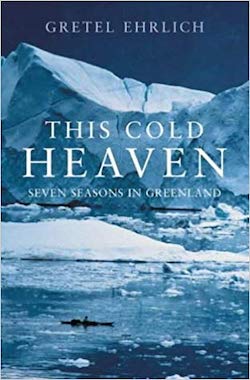
Greta Ehrich visited Greenland in the early 1990s. That was the first of many trips, as she fell under the spell of the place and its people.
“My first trip to Greenland was in the summer; the second trip took place in the dark time…when black days give way to black nights. After that my visits became chronic as if darkness laid down on ice held secrets I could not yet fathom. Though I visited there in every season and the interstices in between, I came to prefer ice and a failing sun to summer’s warmth and open water.”
Ehrlich intersperses the chapters on her time in Greenland with accounts of the expeditions of Knud Rasmussen, a Greenlander-Danish explorer, to document the Inuit culture in the early 1900s. The result is immersive—you feel the cold and the hunger, sense the dislocation caused by endless dark of endless light and get to know the people and their ways. She makes friends in Greenland and learns enough of the language to get by.
Greenland, the world’s largest island, is an autonomous territory within Denmark. The Inuits, its native population, survive mostly on hunting. If the hunting is bad, if the caribou take a different route or seals are scarce, then there is no food.
It is a unique world. There are no trees. Dogs are all-important―they provide the transport, pulling sleds over vast icy spaces so that hunters can find food. Without dogs, there is no food. They are the first to get fed; humans then eat the leftovers.
The people Ehrlich meets and befriends are an important part of her journey. In Ubekendt Ejland, she stays with Hans and Arnnannguaq and becomes very close to their young daughter, Marie Louise. The two communicate perfectly in spite of not having a common language. She meets not only the Inuits but those who have chosen to live in Greenland, making it their home, like Ikuo Oshima, who came to the island in 1972 from Japan and never left.
The landscape is stunning. Ehrlich describes the scene from the boat: “We entered a forest of icebergs. The path between was chrome and slake, a mirror that did not reflect. It was ripple-battered, then smoothed. Icebergs creaked. Bits of rubble skidded down sleek walls. Arctic gulls shrieked, rising up, looking for food. The glazed wing of an iceberg caught the light. From one translucent arch, a row of blue tears fell.”
Ehrlich does not romanticize the way of life; it is hard but has a lot to teach us. Inuit society is communal, without the concept of private property or privacy, and people look out for one another. What this book showed me was that there is a different way to live, a way that does not involve endless consumption and competition. But even here, the modern world is impinging, and it might just be a matter of time before this centuries-old way of life becomes a memory.
This review first appeared on Women on the Road.

 Women's Travel Books
Leave a comment