
Published by Hachette, 2007, 320 pages
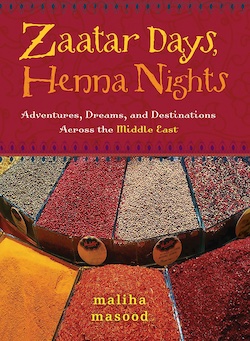
“Listen, are you breathing just a little, and calling it a life?” This quote from a poem by Mary Oliver obviously touched a chord with Maliha Masood, since she used it at the beginning of her book.
Fed up with an uninspiring job in the dot.com industry, she decides to travel to bring some colour into her monochrome life.
Originally from Pakistan, Masood moved with her family to the US when she was 12. She is a mix of the two cultures and sometimes feels caught between them, and thinks that the journey might help her understand herself better.
She started with Europe but then focused on the Middle East. Her trip took place over a year and a half from 2000 to 2001, ending a little before the 2001 attacks. The countries she visited, especially Syria, were very different places then, something that adds poignancy to her account.
Masood believes in understanding a place, so she lives in each city for a while—weeks or months—and gets to know local people. She first goes to Egypt, then to Jordan, Syria, and Turkey, stopping briefly in Lebanon.
Masood steps outside her comfort zone, learning to trust strangers, making this a journey in more ways than travel. The strategy works, apart from some minor mishaps, including her brief kidnapping by a man who wants her as his second wife (she escapes by jumping out of a window).
She makes friends everywhere. In Cairo, she meets Mohammed, who invites her to his family home for iftar, the meal that breaks the fast during Ramadan. She spends time with Bedouins in Jordan and is enchanted by the desert, “a simple space that stripped the bulkiness of life, if only for a moment”.
These are the encounters that enrich her experience. “My friends were cultural windows to another world that was no longer abstract, that was an intricate tapestry whose textures and colors I was getting to…see up close.” When she returns home, it is a stronger, wiser woman who is more at peace with her multiple identities.
What I found interesting was that Masood, an outsider to the region—from South Asia rather than the Middle East—provides a different perspective. She takes chances that she would not have taken in the West, and finds that people are welcoming, open and curious about her life.
But what is most important is that Masood reveals the richness and diversity that is hidden behind the media’s coverage of the region as a place of conflict, closed minds, and fanatically religious people. We need to be reminded, especially now, that we are not that different from each other.
This review first appeared on Women on the Road.

 Women's Travel Books
Leave a comment