
Published by Moyhill Publishing, 2018, 254 pages
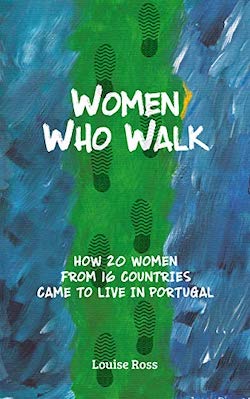
What motivates someone leave the country of their birth to live and work elsewhere?
Louise Ross tries to answer this question by talking to 20 women from a variety of backgrounds who moved to Portugal. She got to know these women—in their 40s, 50s and beyond—as president of the association International Women in Portugal. And they have fascinating stories to tell.
You’ll meet Sally Hastings, who grew up in a cult in the US that did not believe in modern medicine. At 16, she was offered a modeling job in Paris and left, encouraged by her parents (much to her surprise!). She studied bartending in New York and has lived in Spain, Switzerland, and Greece. She is now married to a Portuguese man who manages a touring show for a cabaret, for which Sally worked as the dresser for many years.
And then there’s Sandhya Acevinkumar, whose grandfather left Gujarat, India, in the 1890s on a Portuguese caravel and landed in Mozambique, where Sandhya was born and grew up. In 1976, after Mozambique’s independence, life became difficult for Indian immigrants, so the family left for India and then for Portugal in 1978. After secondary school, Sandhya agreed to marry a man chosen for her by her parents. Things were not smooth and her husband felt threatened by her intelligence and efficiency in business. Sandhya has now made sure that both their daughters have gone on to university and are free to marry anyone they choose.
And finally, Tody Cezar is an American with a Jamaican mother and a Ukrainian father. At 19, she married her boyfriend so they could travel around Europe (you couldn’t take off with your boyfriend then). But he was gay, so the marriage was fairly short-lived. She studied art restoration in the UK, eventually working with the UN to restore churches and mosques in Kosovo.
These are just three of the stories in this book. Most of these women left home because they were curious about the world. Once their horizons widened, they were no longer content to go back to their old lives.
My one criticism: the book could have been longer. I would have loved to know more about these women, and some of their stories could almost be novels in the making.
The book brings home the fact that people have been moving since time immemorial, and that travel opens up your horizons. These women pushed beyond their comfort zones—sometimes far beyond, but they have gained a wider worldview and most have become true citizens of the world. The other thing I took away from Women Who Walk is how comfortable they all feel in Portugal and how welcome they are made to feel there.
This review first appeared on Women on the Road.

 Women's Travel Books
Leave a comment