
Published by Penguin, 2019, 304 pages
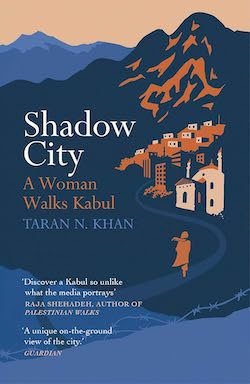
“The stories we tell are often crafted from imperfect memory, drawing on what we remember, forgetting the rest. This is also true of cities, where what we see is only that which is recalled, what is apparent. Sometimes this forgetting is unwittingly inflicted, caused by the convulsions of war or the eroding passing of time. At other times it is deliberate, a conscious strategy of erasure. I sought out what was forgotten in Kabul as a way to map this batin [hidden] city.”
When Taran N. Khan landed in Kabul, the first thing she was told was never to walk. Thankfully, she ignored the advice. She shows us another side of Kabul—the one where people live and love and go about their everyday lives, rather than the version on the news, with bombs and soldiers (these make only peripheral appearances).
Khan, an Indian journalist, made several trips to Kabul between 2006 and 2013. Her connection to the city began long before. Because her family are Pathans who are originally from Afghanistan, her grandfather knew the city well without ever having been there. She is close to him, and his presence permeates the book: he is her guide to the city.
She sets out to map Kabul, focusing in each chapter on a different aspect: bookshops, cemeteries, films, addictions and trauma, and love. She takes us to the shrines and gardens and down its winding streets, giving us a real sense of place.
A second-hand shoe shop owner says to his customers as they walk out with their new purchases, “May you wear them with joy”. Khan wanders through a “labyrinth of narrow book-lined gullies [lanes]” with boys running up and down ladders, returning “triumphant with a book that I had asked for, or just one they felt I should have”.
She is introduced to an ex-Afghan army veteran, who had served under the communist government, and a former mujahideen commander. The two men, who were once on opposite sides of the war—in fact one of them had tried to assassinate the other and missed by sheer luck—now sit down regularly for a cup of tea together.
She intersperses her accounts with memories of growing up in Aligarh, an Indian town. The relatively conservative upbringing prepared her for Kabul: young women walking on their own in India are subject to the male gaze. This made her not only appreciate walking as a luxury but also to be sensitive to no-go areas. All of this is very familiar, as I also grew up in India.
So is Kabul. I spent four years there in the early 70s as a child (before the wars), and recognize some of the places that Khan describes. But so much has changed. This is a portrait of a city in flux. Neighborhoods that were destroyed are being rebuilt; one of the neighborhoods is full of “poppy palaces”, luxurious mansions built with money made from opium.
Khan writes beautifully and perceptively. Some of her passages are lyrical, as when she writes about the graves: “I found the paths I wandered in these cemeteries were like veins—leading to the many shades of loss that run through Kabul. The city is marked by absence, of which a plot in a cemetery is merely the simplest manifestation.”
This is a book worth reading, an introduction to the heart of a city that we see frequently on the news but know so little about.
Read my interview with Taran N. Khan.
This review first appeared on Women on the Road.


Leave a comment