
Published by Gazelle Drake Publishing, 2002, 408 pages
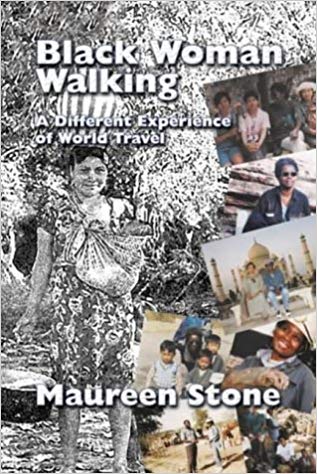
Black Woman Walking is a wide-ranging book—Maureen Stone is not just a hiker but also a sociologist. She travels widely and walks everywhere she possibly can, in Africa, the Americas, Asia, Australia, and Europe. She is not just interested in a place from a visitor’s point of view but in the social issues that shape the culture. Her focus is on people, who provide insights into the country.
Stone was born and grew up in Barbados, and her first time abroad was on a scholarship to Calcutta (now Kolkota), India. That experience shaped her—the racism she encountered toughened her up. She also made good friends and also met her husband, Peter, an Englishman. Their love of walking brought them together.
The structure of the book isn’t conventional. The sections of the include “Letters to my sisters”, where she writes unposted letters to the women she has met over the years—Chinese, Yugoslav, Indian, Caribbean, sometimes saying things she did not say and sometimes talking about their shared experiences. This is followed by “Walking and talking with my brothers” about her meetings with men, the first of which, appropriately enough, is a meeting with her estranged brother.
Stone’s defining quality is an interest in people and an ability to see below the surface. In Bhutan, she meets a monk who tells her about the country’s marriage customs. Later, she makes a point about authenticity. It didn’t matter how truthful his narrative was, what mattered was “that I had been allowed to share in a vision of his society, and that for a few brief moments I felt myself to be part of that world”.
There is much to draw from in this book. On a train in Canada, she starts talking to a woman only because their sons play together. The two women couldn’t be more different: a white, deeply religious housewife and a black, atheist academic. But the two have remained friends, even after the boys lost touch.
There is also plenty of humour. In Tobago, she and Peter sail to Paradise Island with a local fisherman to see the bird of paradise. The fisherman, realizing the couple was concerned about the lack of life jackets and an anchor (he forgot to bring it), thrust fishing rods into their hands. Soon they were so busy catching fish, they had no time to think about drowning!
In Trinidad, on the spur of the moment, she joins a group of students heading up El Tucuche mountain to look for little golden frogs. They don’t find the frogs and on the way down, Stone almost falls down the mountainside: “I realized that robot mode wasn’t quite the thing for this occasion”.
This book is rich: Stone not only writes about interesting encounters with people but also about social issues like racism and child abuse, the sociology of hiking, friendships between women, the history of travel writing, and how the voices of women, especially black women, have been marginalized. This book should help change that.
This review first appeared on Women on the Road.

 Women's Travel Books
Leave a comment