
Published by Penguin, 2007, 1,232 pages. First published in 1941 in two volumes.
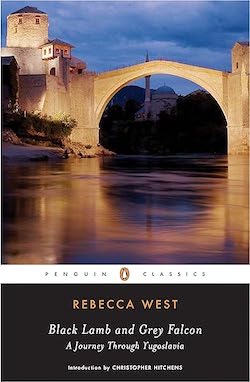
This book, first published in 1941, is a travel classic and a priceless source of information about what used to be Yugoslavia.
Rebecca West travelled with her husband through Yugoslavia in the late 1930s, at a time when the Nazis were gaining power in Germany, and war seemed a possibility.
She visited Croatia, Dalmatia, Bosnia and Herzegovina, Serbia, Macedonia and Montenegro. The country was relatively young, officially recognized as the Kingdom of Yugoslavia in July 1922. Her book is a combination of her travel diary, the region’s history and reflections on ideas such as authoritarianism and democracy.
The book provides insight into interpersonal relationships at the time. The couple are accompanied for most of the trip by their friend Constantine, a Serbian Jew. He is ebullient, intelligent, curious—all the things valued in a travelling companion. But that changes once his German wife Gerda joins them. She is quick to take offence and full of superiority, dismissive of anyone who is not German. Sadly, Constantine defers to her and starts to take on her attitudes, to the dismay of West and her husband. The couple are so clearly drawn that I felt I knew them. (I have met people like Gerda and have much the same reaction to them as the author.)
What Black Lamb and Grey Falcon brought home to me was the complexity of this region’s history. It had known upheaval for centuries, with Austria, Hungary, Venice, Germany, and the Ottomans jostling to rule it, resulting in endless wars and political manoeuvring.
As they sail into Trogir (now in Croatia), she describes the vista: “It is one of those golden-brown cities: the color of rich, crumbling shortbread, of butterscotch, of the best pastry, sometimes of good, undarkened gravy. It stands naked and leggy, for it is a walled city deprived of its walls. The Saracens leveled them, and the Venetians and the Hungarians would never let them be rebuilt. … On the quay stand Slavized Venetian palaces with haremish lattice-work fixed to screen the stone balconies, to show that here West meets East, brought thus far by Byzantine influence and perpetuated by the proximity of the Turks.”
She includes a long, but fascinating, chapter of the assassination of Franz Ferdinand in Sarajevo on 28 June 1914—the events leading up to and following it, the people involved, and how chance sometimes plays a role in directing the events that change our world.
Franz Ferdinand’s trip to Sarajevo was a secret, and therefore one with no security arrangements. His wife Sophie was a commoner, and not entitled to Ferdinand’s honors. So he traveled to Sarajevo to inspect the military without informing civilian authorities and without security, leaving him an open target.
West says, “It has always interested me to know what happens after the great moments in history to the women associated by natural ties to the actors.”
She finds out when the couple meets the sister of Chabrinovitch, one of the men who attempted to assassinate Ferdinand on that fateful day. Chabrinovitch failed and jumped into the river. Later that day, the authorities came for the father, leaving the mother and sister alone. They escaped but ended up in an internment camp in Hungary. The mother was bewildered by the events: “Her eldest child had tried to kill the Archduke and his wife—apart from anything else, she felt it was too grand for us, it could not happen.” An event that changed the world brought down to its human elements. These are not just names anymore, they are real people who fought and suffered.
This is just one example from a book packed with them. West moves smoothly between the past and the present, finding the stories and people behind the history.
This is not for those who want a quick read: it is a highly researched and detailed account of a country, as thorough as it is possible to be. Some of her attitudes feel outdated now, but remember she was writing 80 years ago, in a different time.
This review first appeared on Women on the Road.

 Women's Travel Books
Leave a comment