
Published by ONEWorld Publications, 2011, 224 pages
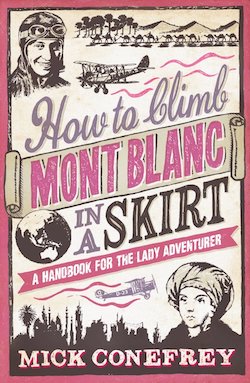
“Take every precaution and abandon all fear.” Mary Hall, c. 1905
Why is it, when asked to imagine an explorer, people inevitably think of a sunburned unshaven white man squinting into the sun? The truth is that there were many intrepid women explorers, who for some reason did not get the kind of publicity the men did. (In an earlier book he wrote about adventurers and explorers and universal travel themes but then realized nearly every protagonist in that book was male.)
In this book, Mick Conefrey tries to remedy the omission. He found that women discovered the lost city of Cana in the Middle East, mapped the Sichuan Glacier in the Himalayas, reached the top of the Huascarán in Peru, became the first European to visit an Ottoman harem, and held the record for the fastest flight from Britain to Australia for 44 years.
And Conefrey is not writing about modern women. The lady in the Ottoman harem mentioned above was Lady Mary Montagu, who visited Constantinople in 1716. She decided to set the record straight about harems, saying that the men who wrote about them had no idea what they were talking about. (Naturally, she was right.)
Women were constantly being patronized. (Not that this has changed that much.) When British novelist Charlotte Mansfield made a difficult journey to Africa in 1908, a newspaper asked if she would agree to get lost so they could get an exclusive on her “rescue”.
Rosita Forbes, an explorer in the early 20th century, was criticized for being too young and pretty to be an explorer. And of course, everyone (except women climbers!) knew that women couldn’t climb mountains because they had difficulty coping with high altitudes.
In 1929, Miriam O’Brien and Alice Damesme scaled the Grépon, a difficult peak of the Mont Blanc Massif on their own, to the fury of a French climber, Etienne Bruhl: “Now that it has been done by two women, no self-respecting man can undertake it.”
The book is anecdotal rather than a narrative, but Conefrey paints a vivid picture of these women, listing the clothes they traveled in and the equipment and food they carried. Henriette d’Angeville, the second woman to scale the Mont Blanc in 1838, wore 14 pounds of clothing, including silk and wool stockings, flannel-lined trousers, a blouse made with six layers of wool, a fur-lined bonnet, a furlined cloak, nailed boots and three pairs of gloves. We should be thankful for the invention of GoreTex!
The book is also peppered with useful tips: how to dodge a crocodile, why you should not take a cheetah as a passenger, and why you should never let a gorilla near your bedroom.
Conefrey is intrigued by how men and women approach travel. He does find differences between individual men and individual women, but there is more that unites than separates them. Women are far from being the timid souls imagined (or wished for) by men, he concluded. They often traveled on their own, fending off unwanted attention and dealing with whatever fate threw at them. Before she made the epic flight from Britain to Australia in 1930, Amy Johnson ⎯ Britain’s answer to Amelia Earheart ⎯ had not even crossed the English Channel. She used linen shirts and Band-Aids to mend the wings of her plane, but she made it.
Conefrey takes us back to a much earlier time, a time when attitudes were very different to what they are now. This is an inspiring book ⎯ not just because of the amazing voyages of these women but because they made them against all the odds stacked against them.
A version of this review first appeared on Women on the Road.

 Women's Travel Books
Leave a comment