
Published by Catapult, 2020, 284 pages
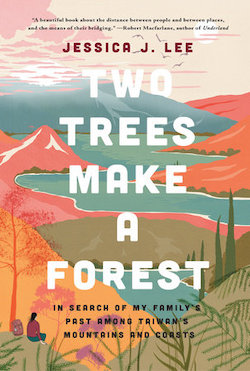
“I saw in Taiwan something of the ways that places draw us in—and sometimes push us away again—and there grew in me an inarticulate longing.”
This is a lyrical book about home, language, the immigrant experience and finding your roots.
Jessica J. Lee was born in Canada. Her mother moved there from Taiwan with her parents, whom Lee called Gong (Chinese for grandfather) and Po (grandmother). Lee’s relationship with them—especially with her grandfather, whom she was close to—is central to this book.
After Gong moved back to Taiwan and died there, Lee and her mother went to visit his remains. This was only the second time Lee had been to Taiwan, but something about the island touched a chord in her.
“It was as if we were finding in the landscape an expression of this place and our lives beyond my grandfather’s death, beyond a past I did not fully understand. I developed a love for these mountains and their forests, a need to return and return again.”
Lee returns to Taiwan and spends several months there, travelling through the country. She is an environmental historian, and much of her writing about Taiwan focuses on its natural beauty. Along the coast, she goes looking for the elusive black-faced spoonbill. Hiking in the mountains, she wakes in her tent after a storm, finding “[t]orrents of water” howling past. She writes about the effect that climate change is having on the island and how the government is trying to battle it.
This is also a story about her family and what it means to be an immigrant. Gong’s life is one of the threads running through the book. Lee draws on a letter he wrote to her mother towards the end of his life, by which time he was suffering from Alzheimer’s. Twenty pages long, written in Chinese, it was an “autobiography of his life, looping around and repeating his story”.
Lee’s grandparents both moved to Taiwan from mainland China when they were young. Adjusting to life in Canada wasn’t easy. Gong was a colonel in the Chinese Air Force and thought he could fly for commercial airlines in Canada. But since Taiwan was not recognized as a country, his credentials did not carry over. It would have taken five years for him to get the clearance to fly, by which time he would be over the age limit. So instead he worked as a cleaner in a factory, spending his days mopping floors.
There is so much to this book. Lee writes about language: “Languages become a home. In English, I find my mind, and in German, my present life in Berlin. But my earliest words were in Mandarin, my mother’s tongue. I know them still.” She scatters words in Mandarin throughout the book, explaining not only their meaning but how the logograms are put together. I found this fascinating.
I loved this book. I learned a lot about Taiwan: its history, and its flora and fauna. But the heart of Two Trees Make a Forest is the story of Lee’s family. It’s beautifully written, and made me want to go visit the country.
This review first appeared on Women on the Road.


 Women's Travel Books
Leave a comment