
Published by Farrar, Straus and Giroux, 2017, 336 pages
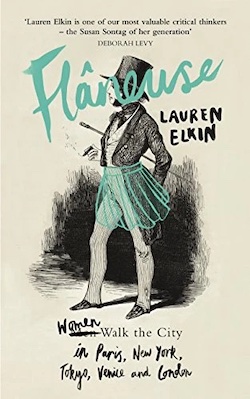
Flâneur is a French word that means “one who wanders aimlessly”. It always refers to a man with time and money, who walks the streets of a city. Elkin appropriates the concept by feminizing the noun. And she is not the only flâneuse: there have been many before her, some of whom are in this book.
Elkin grew up in the suburbs of New York where she needed a car to go anywhere. When she moved to New York City, it was liberating to be able to walk everywhere. Walking for Elkin becomes the only way of knowing a city. Being a flâneuse means having time to notice what the French writer Georges Perec calls the infraordinary: “What happens when nothing is happening”. Like sitting at a café and watching life go by.
In each chapter, Elkin introduces us to another flâneuse: the writer Virginia Woolf in London; the artist Sophie Calle in Venice; and in Paris, the writer Jean Rhys, the writer and socialist George Sand and film-maker Agnes Varda. There is also the photographer and writer from New York, Martha Gellhorn, who travelled widely, including to Spain during the Civil War. Tokyo gets Charlotte, a fictional character from Sophia Coppola’s film, Lost in Translation. But more about that later.
Paris is the center of this book. Elkin goes to the city to study, falls in love with it and stays. She talks about what it means to be an immigrant, and how you are always caught between where you live and where you are from (something I completely identify with).
Writing about her own experience interspersed with those of a woman from another time provides a multi-faceted glimpse of the cities. For all the women, walking was liberation and in the cases of Woolf and Sand, a defiance of convention. Woolf and Sand moved to the city from the country, finding freedom on the city streets. Sand started dressing like a man because she found women’s clothes impractical, and she attracted much less notice.
I found the chapter on Tokyo disappointing. Elkin moves there because her boyfriend gets a job. She hates it—she can’t walk anywhere and has trouble adjusting to the culture. The other woman here is Charlotte—disconnected, lost. Elkin does end the chapter by saying she grew to love the city and would want to go back, but does not really tell us why.
This is not a conventional travel book, and parts of it are a bit slow, but I loved the fact that Elkin appropriated the term flâneur for women. I think I am a bit of a flâneuse myself!
This review first appeared on Women on the Road.


Leave a Reply