
Published by Mountaineers Books, 2018, 272 pages
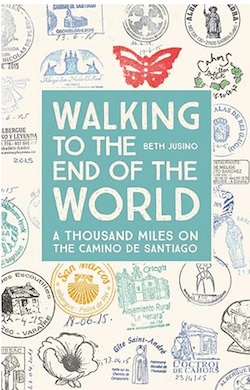
Beth Jusino is a publishing consultant living in Seattle. She and her husband Eric have jobs they enjoy, but feel that something is missing in their lives. So they take three months off work to walk from France to the cathedral of Santiago de Compostela and on to Finisterre (which translates as the end of the earth) in Spain.
Jusino doesn’t realize just how much of a challenge it will be: she is used to walks in the park, not for months on the road. The couple had not travelled outside the United States, and Jusino’s knowledge of French was “la pomme est rouge” (the apple is red), not of much use as not a single person asked her about apples the entire time she was in France.
The camino de Santiago, as the path is known in Spanish, is said to be divided into three, no matter how much of it you walk: the first third is a test for the body, the second a test of the mind and the final third a gift to the soul. And so it proves for Jusino.
For several days, her feet—she calls them Princesses because they feel every pebble on the path—hurt constantly. The pain eases once she buys new shoes by which time, she realizes, she has walked 360 miles across southern France!
Crossing the Pyrenees into Spain proves to be difficult: not only is it a gruelling, steep climb, but there is a strong wind that Jusino feels is going to blow her off the mountain. She has a panic attack and is ready to give up when she walks around a bend and sees sheep. Her dream was to walk along a herd of sheep, and just seeing them calms her down and lifts her spirits.
As for the gift to the soul, Jusino learns to accept the things she can’t control, like noisy neighbours, poor service and musty rooms, but also the gifts the camino sends her way, like a cool glass of water offered by a stranger or the soup cooked by the abuelo (grandfather) in one of the Spanish albergues (hostels). But most important are the people along the way, fellow pilgrims and people who run the gîtes and albergues.
At the heart of the book is how slowing down can change your perspective. Instead of rushing around and spending a lot of time staring at screens, walking gives you the time to look around, get to know people—even yourself—and to think. It is time out and one of the reasons that I would someday like to walk the camino.
This book inspires me to do it. Jusino proves that you don’t have to be on top of your form to take on a challenge like this. The trick is just to do it rather than dream about it. In the end, this desk-bound woman walked 1,000 miles in three months. And that is something to be proud of!
This review first appeared on Women on the Road.

 Women's Travel Books
Leave a comment