
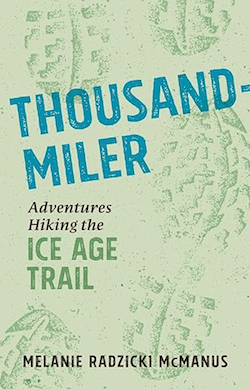
Published by Wisconsin Historical Society Press, 2017, 240 pages
In 2013, 51-year-old Melanie Radzicki McManus felt she needed a break from everyday life. A native of Wisconsin, she is delighted to find that there is a National Scenic Trail on her doorstep: the Ice Age Trail. Seeing it as an opportunity to get to know her state better, she challenges herself not only to hike the entire 1100-mile trail from west to east but also to beat the fastest known time (FKT) set by a woman. Of the 22 thru-hikers until then, only three were women.
The trail follows the contours of the last growth spurt of the ice that covered much of Canada and the northern United States during the Ice Age. The ice made a final push deep into Wisconsin before it started to recede, leaving behind glacial detritus which can still be seen. The trail was created in the 1950s by Raymond T. Zillmer, an avid hiker, and mountaineer, following the contours of this last growth spurt.
However, to be able to set an FKT, Radzicki McManus will need help: she cannot be loaded down with tents and provisions. This means that there will be people crewing her – meeting her at designated places with provisions and supplies – and she will be spending nights in motels and inns. Her family and friends rally around, taking turns.
It isn’t easygoing. She hurts her knee on day 2 (it eventually heals); she develops cellulitis on her foot, which is extremely painful; and trail markers are sometimes hidden or disappear altogether. Plus, hiking in the blistering sun in patches without a single tree in sight is not fun.
But the path also winds through some spectacular places. Kettle Moraine is “pitted with kettles [large crater-like depressions] and dimpled with lakes, studded with pine woods and hardwood forests, alive with the sounds of rustling prairie grasses, warbling songbirds, burping frogs and more.”
Thousand-Miler is not just Radzicki McManus’s story. Interspersed with her journey are chapters about the trail’s history and the stories of other thru-hikers: Jim Staudacher, the first person to hike the entire trail when he was 19; Jason Dorgan, who finished the trail in 22 days and 6 hours; and Jenni Heinz, an army vet who was in Afghanistan. Heinz was part of a program called Warrior Hike, set up in 2012 by former vet Sean Gobin to help his fellow soldiers deal with the post-stress traumatic disorder.
I enjoyed the challenge that Radzicki McManus set herself and saw through in spite of several hiccups. There are moments of despair and pain—as there are in any major challenge—but she is clearly in love with the trail, and this comes through in the book. In fact, she went back a couple of years later to hike it from east to west, which made her the first thru-hiker in both directions.
So if you feel you need to escape from your routine and try something new, let yourself be inspired by this book!
This review first appeared on Women on the Road.

 Women's Travel Books
Leave a comment