
Published by Nicholas Brealey Publishing, 2017, 287 pages
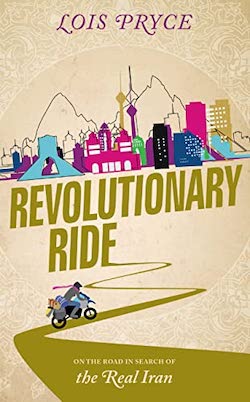
One evening in Kensington, London, Lois Pryce finds a note left on her motorcycle from a man called Habib: “I have seen your motorbike and I think you have travelled to many countries…. I wish that you would visit Iran so you can see for yourself about my country. WE ARE NOT TERRORISTS!”
This was in 2011, at the height of tensions between the UK and Iran. Intrigued, Lois decides to take Habib up on his offer and visit his city, Shiraz.
She takes a train from Turkey across the border and rides her bike to Shiraz, going through Tabriz, the Alborz mountains, Tehran, Isfahan, Yazd and Persepolis. Navigating is a challenge—most of the signs are in Persian and her maps are hopelessly outdated (she is determined not to use GPS). But she is there to see the real Iran and takes it in her stride. Dusk often finds her on the road, hoping to find somewhere to stay the night.
Throughout her trip, complete strangers invite her to join them for a meal or invite her to their homes without any awkwardness or formality, like the Baha’i mother and son she meets on the train. She falls in love with the country and finds its people generous, funny and resourceful. What I found interesting was that, although women are treated as second-class citizens and told what they can or cannot do, Iranian women do not behave like victims. They have their own ways of challenging the system.
She meets ordinary Iranians throughout her trip: the family who give her a crash course on Iranian customs; the teenage girl who wants to become a doctor so she can leave the country; Raha, the businesswoman who wants to go into luxury goods; and Nahid, who runs a small hotel in the north, caring for her sick father and her brother, a recovering crystal meth addict.
But hardliners and the dreaded Revolutionary Guard (the moral police) are a reality, and they would not be friendly to a woman travelling alone. Pryce lives with the possibility that she could be imprisoned. She does have a couple of (thankfully) minor run-ins with the Guard but gets away unscathed. On the whole, she feels safe as a woman, more a curiosity than prey.
My favourite moment is at the point Pryce crosses over into Iran. By now, the entire train knows she has a bike and is going to ride across the country. Standing in line for seats on the onward train, she notices an older woman in a chador staring at her. The woman wants to know if Pryce has a “motor”. All of Pryce’s paranoia surfaces: she is convinced that the woman is a hardliner and will report her to the authorities. She tries to avoid answering but the woman is insistent: “Vroom, vroom! You have motor, yes? It is you?” Pryce admits it. A big smile spreads across the woman’s face. She gives Pryce a big kiss and starts jumping up and down, imitating riding a bike like a daredevil, her chador flapping around her. “Very good! Very good!” Her parting words to Pryce are: “Go and wake up your luck.”
This review first appeared on Women on the Road.


 Women's Travel Books
Leave a comment