
Published by HarperCollins India, 2008, 299 pages
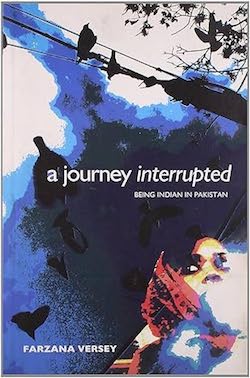
This book about travelling in Pakistan is particularly interesting because the author is an Indian Muslim woman, whose various identities affect the way she perceives and is perceived by Pakistani people. Farzana Versey travelled several times to the country between 2001 and 2007, and A Journey Interrupted is a series of vignettes from her trips.
A bit of history is needed to understand the impact Pakistan has on Versey. In 1947 the Indian subcontinent was split into India and Pakistan. Pakistan became a state for Muslims and in history’s greatest migration, some 14 million Hindus, Muslims and Sikhs moved from one side of the border to the other. The migration was extremely violent, with massacres on both sides and an estimated half a million people killed in a religious genocide.
Many of the scars still run deep, which partly explains the ongoing tensions between the two countries. The years have improved things somewhat but an Indian travelling in Pakistan can still provoke strong reactions.
The book begins with one of Versey’s trips being cut short: she is deported because her visa runs out. She applies for an extension but is told that she is “from the wrong country”. The retired army general she speaks to says: “We gave you an opportunity [as Muslims] in 1947. … Your family should have come then.”
Versey’s family, like mine, chose to stay in India and lived too far south to be directly affected by the partition. As far as we were concerned, India was home. But for some people this remains unimaginable—one woman asks her how it feels to not live in your own country.
Versey travels alone. Pakistan is in many ways more conservative than India. One of her guides, a man, is embarrassed to be seen with her. When they go out for a walk, he complains she walks too confidently and displays too much curiosity.
But people also open up to her. She meets writers, musicians, poets, chaiwallahs (tea-sellers) and prostitutes. Versey breaks through stereotypes to reveal a complex nation where the “personal becomes the political”.
She talks to journalists. Contrary to the popular perception of Pakistan, there exists a critical and fairly vocal press, which finds ways around the occasional attempts by the government to silence it. She learns about the gay community from a gay woman, a courageous member of a (still illegal) minority in a country that stigmatises homosexuality.
Versey gave me an insight into a country that neighbours mine and to which I have never been. It is a highly personal book but because it takes place over several trips, it may come across as a bit disjointed, with writing that is occasionally a tad clunky. But I recommend it for a nuanced portrait of a nation.
This review first appeared on Women on the Road.

 Women's Travel Books
Leave a comment