
Published by Penguin, 2018, 201 pages
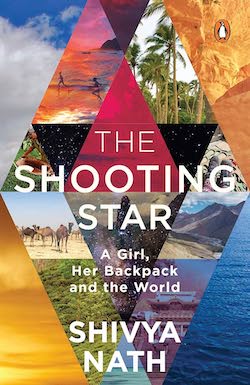
The Shooting Star starts with Shivya Nath deep in the Amazon rainforest (around the border between Ecuador and Peru), taking part in a shamanic cleansing ritual that involves drinking ayahuasca, an Amazonian plant that is also a potent hallucinogen. She not only survives the experience but cleanses her negative energies in the process.
This experience is a long way off from Nath’s protected childhood in Dehradun, a small town in northern India. She goes to Singapore to study, following in her brother’s footsteps (the reason she was allowed to go), and eventually gets a job at the Singapore Tourist Office. But something doesn’t feel right. So she gives up a steady job with good pay to go traveling, much to her family’s horror. And to make it worse, she not only travels on her own but goes far away.
This book is not just about travel, it is about a journey—a journey of self-understanding, a search for solitude, and a need to conquer fear. Looking for a way to disconnect herself from the busy world around her, Nath travels to remote indigenous communities in Latin America and India and hikes the mountains of Ethiopia.
In Guatemala, she stays with a Mayan Itza family while she learns Spanish. The Mayan Itzas choose to live in the forest near Lake Peten Itza, relying on the rainforest for food, herbs, and medicines. Nath learns that the Mayan Itzas had been forbidden from speaking their own language or wearing their traditional dress on pain of beheading, and in a village of 2800, only 34 people spoke Itza.
In the Simien National Park in Ethiopia, she slips away from her guides to walk along a narrow ridge with a stunning green valley on one side and a sheer drop on the other. “A feeling of exhilaration washed over me when I finally reached the edge, for there I stood, far from everyone and everything I knew, a spectacular vista of stark volcanic peaks before me.”
In Rajasthan, India, she goes out into the desert with the son of a visionary conservationist and watches a meteor shower in the night sky; in Mauritius, she strikes up a friendship with a fisherman; in Ladakh, she makes friends with very young nuns in a Buddhist nunnery; and in Costa Rica, she stays with an indigenous Bribri family of cacao farmers, who welcome her with delicious, dark, bitter chocolate, drunk without milk or sugar.
She is frequently asked why she travels alone (a question a man would not be asked). As a girl, she “was afraid to break rules or…venture out beyond the imaginary boundaries of right and wrong and success and failure defined by someone else. … I desperately wanted to be a different me—courageous and unafraid.” She also wanted to prove that the world wasn’t the horrible place it is made out be, the fear that “compels people to stay at home—trapped in a shrinking comfort zone—as it had once compelled me. I had much to unlearn for the sake of the freedom I chased, the victimhood I despised, and my mission to build unlikely friendships.” And with her travels and this book, that is exactly what she does.
This review first appeared on Women on the Road.

 Women's Travel Books
Leave a comment