
Published by Random House, 2004, 416 pages
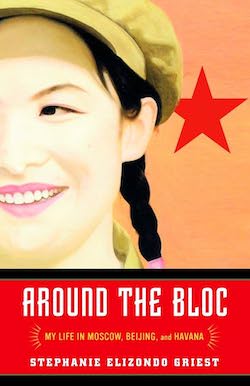
Growing up in Texas, Stephanie Elizondo Griest dreams of becoming a foreign correspondent and roaming the world. The advice of a journalist to learn Russian opens the door to what turns into a “four-year, twelve-nation tour around the Bloc” of communist or ex-communist countries. This book focuses on Griest’s stays in Russia, China, and Cuba.
She visits Russia as an exchange student. Sitting on the ground to wait for her group, she is hauled to her feet by a babushka (grandmother), who scolds her for sitting on the cold ground: “You’ll freeze your ovaries.”
It is 1996, a few years after the end of the communist Soviet Union and things are changing. Young Russians look down on anything communist, while some of the older generations are nostalgic. Griest dates Alexei, who managed to escape cleaning up Chernobyl by slitting his wrists just enough to get sent to an asylum for the mentally ill.
She learns that, for a party, you need a bottle of vodka per person plus one more. She comes into contact with a range of people: an old couple in a village, who are appalled that her mother does not keep her own pigs; affluent men who get their money from “biznes” (connected to the Russian Mafiya); and abandoned children at the orphanage where she volunteers.
But Griest wants to live in a genuine communist country. So she picks China and gets a job at China Daily, the Party’s mouthpiece. Her job polishing English copy is a long way from her visions of slipping subversive notes to imprisoned dissidents. Her vegetarianism is one of the first casualties of her stay — it was almost impossible not to eat meat (a term that includes a fairly large range of animals). She gets herself a sturdy Chinese bicycle and a brightly colored plastic poncho for the rain. She becomes friendly with the Uighurs on her street, who make sure she never eats alone.
Griest is half-Mexican, something she was ashamed of growing up. She had never visited Latin America. So when her friend Machi invites her to sneak into Cuba (Americans were not allowed to visit the country), she agrees. They find Cubans gripped by the drama surrounding Elián González, a boy at the heart of a US-Cuba custody battle in 2000. She joins a march of 10,000 mothers demanding his return, sashays with a well-known dancer, and hangs out with young people who share their dreams with her.
Griest starts out as a naïve young woman, sometimes annoyingly so. She matures as she travels. Being exposed to other cultures makes her reassess her own.
This passage from her time in Beijing about people cycling in the rain illustrates her joy at feeling part of what was once a society alien to her. The streets are “a kaleidoscope of yellow, orange, red, green, and purple polka dot. These were the times I felt most part of this world: cruising down the street with a basket full of eggplants, dodging a downpour in a peacock blue poncho, on my way to where I needed to be, with no better way of getting there.”
This review first appeared on Women on the Road.

 Women's Travel Books
Leave a comment