
Published by Harper Collins, 2019, 152 pages
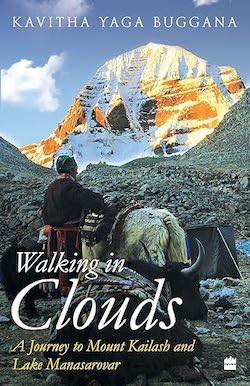
Kavita Yaga Buggana and her cousin Pallu planned to go together to Mount Kailash in Tibet since they were 18. But life got in the way, they both married, moved away from India and had children. But they held onto their dream.
They finally make the trip years later, after both families have moved back home and the two women are in their early 40s. Ignoring the worried protests of their husbands, they take off, joined by a third friend.
Mt. Kailash is sacred in Buddhism, Hinduism, and Jainism, and Bon, a Tibetan religion. According to Hindu belief, Mt. Kailash is where the god Shiva lives with his consort Parvathi. Pilgrims walk the circumference of the holy mountain, a ritual that is supposed to bring good fortune.
They meet up with traveling companions In Nepal: Katy from Hong Kong who lives in Vancouver; Ying, a Chinese woman with a bad leg; Jeff, an irrepressible Australian; Sperello, an Italian astrophysicist; and their guide Chhiring. The entire group is part of this book—the photographs that illustrate it were contributed by them.
Reaching the mountain involves trekking through some fairly high and difficult terrain, and Yaga Buggana, although she has the latest equipment, is not prepared for the intense effort. She finds it a challenge, and the cousins almost call it quits on their first night. But things look better in the morning.
Yaga Buggana captures the effort of putting one foot in front of the other as well as the beauty of the landscape. Like night in the Salli Khola camp in Nepal: “In these heights, the heavens seem to have drifted down, almost touching the earth. The air is cold. The river hums, invisible over rocks. This is the most brilliant sky I have ever seen in my life. As I gaze at the heavens, I feel I am falling and flying, and I become intensely aware of these wondrous stars illuminating a great infinity.”
She writes about the razing of Tibetan monasteries. “It is deeply unsettling to picture the original temple being razed, monks fleeing with scrolls and images, fire and rubble consuming once-sacred grounds. … the sacred object and its essence are inseparable and they are often repositories of important cultural identities. In the old temple, it was not stone or metal that was targeted, but the Tibetan people’s sense of self, their spirit, culture, hopes, and strengths.”
This is not just a travel book: Yagga Buggana intersperses her experience with history, legends and beliefs. The book gave me a strong sense of what it means to make that journey and of the richness of the region’s cultural history. And I admired the two women who were determined to realize their dream, whatever the odds.
This review first appeared on Women on the Road.

 Women's Travel Books
Leave a comment