
Published by University of California Press, 2016, 224 pages
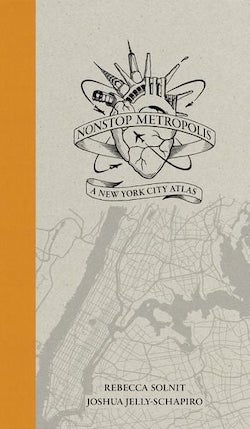
Rebecca Solnit is no stranger to conveying urban environments through maps (see my review of her earlier atlas on New Orleans).
But how do you convey the complexity of New York? Rebecca Solnit has the answer: by breaking it up into its constituent parts and mapping each one. Through these individual maps (with accompanying essays by experts including linguists, music historians, environmental journalists, and ethnographers), a multifaceted portrait of the city emerges.
As Solnit puts it in her introduction, “Each of us is an atlas of sorts, already knowing how to navigate some portion of the world, containing innumerable versions of place as experience and desire and fear, as route and landmark and memory. So a city and its citizens constitute a living memory.” The maps in this atlas illustrate “a few of the myriad ways in which a city can be described and understood”.
New York has existed for four centuries: the land on which Manhattan is built was bought by the Dutch West India Company from Native Americans for the equivalent of $24. It began as “a little Dutch outpost in Lower Manhattan that became a compact British city and then the official capital of the newly liberated United States”. Eventually, the capital moved to Washington, D.C., but New York remained the center of finance, fashion, and the arts. As Solnit says, “Maybe what it means to be a capital is to be a seat not of government but of imagination”.
This book will take you deep into the metropolis. You will learn about the people who shaped New York; the riots that took place there over the years; and the way the city’s water, sewage and trash systems work.
Maps sometimes pull together things that seem disparate but are somehow linked, like harpooning whales and publishing (the link is Herman Melville, who wrote Moby Dick and lived in New York); and brownstones and basketball. Some of the boroughs such as Brooklyn, the Bronx, Harlem, and Staten Island get their own maps.
But it is the people who make a city, and New York has always been a landing place for immigrants. Maps are dedicated to New Yorkers: the one about Jews divides them into those who are Orthodox, slightly Jewish, Black, Secular Humanist, Catholic (yes, really), and so on.
And then there are the women: the chapter, City of Women, reimagines the subway map with subway stations named after famous women – like Ruth Bader Ginsberg, Joan Didion, and Ella Fitzgerald – instead of men.
Also, as the map on Mother Tongues and Queens shows, languages spoken in the metropolis include hundreds of endangered minority ones, such as the Otomanguean languages of Mexico or the Nilo-Saharan languages of Sudan.
My personal favorite map is the one on songs celebrating New York, “the ways that what starts as a particular place can end up as the tune that you hum, a songline with no guidance other than to the human heart”.
I thought I knew New York well, but this book has opened my eyes to its multiple layers. It is worth buying a print copy of this book not only for its beautiful artwork, but also because it will have you spending hours poring over it.
This review first appeared on Women on the Road.


 Women's Travel Books
Leave a comment