
Published by Pantheon, 2004, 290 pages
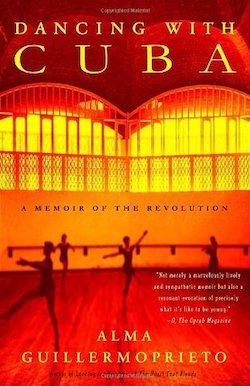
Alma Guillermoprieto is a Mexican journalist who started out wanting to be a dancer. As a young woman, she trained in New York and then spent six months in Cuba in 1970 teaching modern dance. This memoir is her account of her life-changing stay in the country.
Her stay in Havana does not begin well. She takes a dislike to the school’s director, Elfriede Mahler (a North American woman), and the feeling is mutual.
Things do not improve over the six months but since Guillermoprieto is the only candidate for this post, Mahler hires her.
Guillermoprieto falls ill almost immediately and is taken to hospital, where she receives a full medical exam, x-rays and all, something she had never had been able to afford in New York or Mexico. Here, it was free of charge. In a way.
“I’d just been informed that this care was being given in exchange for a certain conduct, a stance towards the world that bespoke my bravery and social commitment.”
At the time of Guillermoprieto’s arrival in Cuba, the nation was focused on the zafra de diez milliones, a push by President Fidel Castro to encourage the Cubanos to bring in a bumper sugarcane harvest of 10 million tons and eliminate Cuba’s dependence on Soviet aid. The entire country seems mobilized around the harvest and it is the main topic of conversation: Will they reach 10 million or not?
She lives in the school dormitory reserved for special guests and begins making friends—Lorna Birsdsall, the assistant director, married to Manuel Piñeiro, in charge of Fidel’s security (everyone referred to Fidel Castro by his first name, which somehow made him feel more approachable). Her closest friends are a group of gay men through whom she learns that going out for ice cream or a meal requires patience: you must queue for hours and even then, it’s not a given. From her students, she learns about the frustrations and dreams of the young.
The author provides a strong sense of Cuba in the early 1970s. I loved her descriptions of the city, like the suburb Vedado (Forbidden), where old mansions slowly crumbled.
“The functional names of the streets–L and 14, 27 and G—contrasted with their extravagant reality. … [W]e glimpsed a turn-of-the-century mansion, protected by wrought-iron gates, covered with vines as if bedecked in lace…and gradually falling apart without losing any of its panache. … How could a revolution—by definition abrupt and radical—have emerged from this city of subtleties and the decadent filigree of light and shadow that filtered always through its vegetation?”
She wrestles with her feelings about the Revolution, at times giving her something to believe in, at others wondering whether it can make room for art.
Ultimately Cuba is the backdrop for the biggest change in her life: she abandons dance and becomes a journalist.
Before Cuba, “I’d never once imagined that belonged to a wider community than that of my friends and fellow dancers”. Cuba teachers her a wider sense of belonging and a common purpose.
This review first appeared on Women on the Road.

 Women's Travel Books
Leave a comment