
Published by Ebury Press / Simon & Schuster, 2008, 295 pages
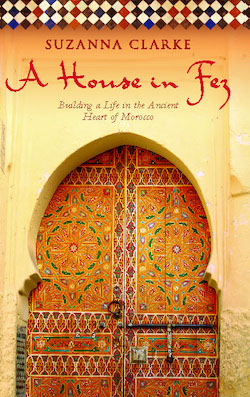
How many times have you been to a place and dreamed about what it would be like to settle down there? Suzanna Clarke fell in love with Medina, the old part of the Moroccan city of Fez. She decided to turn her dreams into reality, leaving behind the rat race in Australia to move to a place where she found a more rewarding way of life, even though she didn’t speak either Arabic or French.
Clarke and her husband start looking for an old house in the Medina that they can afford to buy and restore. The old houses fall into two categories: riads or dars. They both centre around courtyards, but riads are larger and have a garden, or at least a lemon or orange tree. Clarke and her husband finally settle on a riad.
Their new house is situated “at the end of an alley in one of the oldest parts of the Medina. You entered a carved wooden door, ascended some stairs in a corridor, and arrived in a lovely courtyard of about a hundred square metres, complete with an orange and a lemon tree and an attractive fountain.” One of the first-floor rooms is over the neighbours’ kitchen: the houses are constructed almost like jigsaws.
However, this dreamy riad needed a lot of repair. Clarke and her husband were determined to restore it using traditional methods as much as possible, and change only what was necessary, which meant putting in plumbing and a new kitchen.
They move in, and the work begins. Things do not always go as planned. Obtaining the necessary permits requires plenty of office visits and much patience. When they find workmen who understand the old houses and are artisans, they don’t always show up when they say they will. Eventually work begins and the house starts to take shape.
Life in the Medina is centred around human contact. Almost as soon as Clarke moves in, she is taken under the wing of Khadija, her neighbour across the road. Although the two women have no common language, they manage to communicate.
Clark hires a translator, Nabil. One day, they are walking with him down the Medina’s narrow streets and pass a 13-year-old girl in a doorway holding a tray of unbaked bread. She says something to Nabil, he takes the tray from her and delivers it to the baker down the road. When asked if he knows her, Nabil responds: “No, but anyone who lives in the Medina and is walking to a bakery will take someone’s bread.” How will the baker know whose bread it is? “Every family makes their bread slightly differently, and the baker will have been baking it for many years, so he just knows.”
Little by little, Clarke puts down roots, getting to know the people and the place, going to the hamman, shopping at the souk and taking part in a Sufi ceremony. She adopts a chameleon, a cat moves in and life starts to take on a rhythm.
Clarke has a way of bringing the place to life: “The henna souk at the bottom of the Tala’a Kbira is a quiet oasis, with a big plane tree shading a small square crowded with tiny shops selling pottery, pot-pourri, henna, argan-oil soap and rose moisturizer. … For all the souks to function, the goods need to be moved around. Making your way through the streets is a constant exercise in avoidance. You have to squeeze into doorways so that you’re not mown down by heavily laden donkeys or mules, or wiry old porters with impossible loads.”
The book gave me a glimpse into another world and dream for a while of moving somewhere so different from where I live now. And I have to say it was good to live Clarke’s experience of renovating a house—stressful at the best of times—vicariously!
This review first appeared on Women on the Road.

 Women's Travel Books
Leave a comment