
Published by Mill City Press, 2015, 280 pages
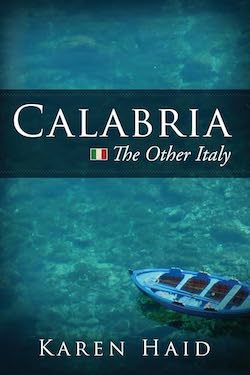
Calabria is the toe in the boot of Italy. It’s the region that non-Calabrese Italians tend to look down on as crime-ridden and backward, something I found out for myself. When I told my Italian colleague that I was reading about Calabria, his reaction was “Why?” Karen Haid sets out to counter this attitude and prove that Calabria has a lot to offer. She succeeds in doing both.
Haid is an American who speaks Italian. She decided to settle in Calabria and support herself by teaching English. As a non-EU citizen, she ran up against Italy’s wall of bureaucracy when trying to get a work permit. On the verge of giving up, she received—and accepted—an offer from a school in Locri, Calabria.
Haid spent her time in Calabria exploring the region. Her descriptions of everyday life are interwoven with the region’s rich history, and both often overlap. Calabria was settled by the ancient Greeks in the 7th and 8th centuries BC. The region of Regio Calabri still has a strong Greek heritage, with road signs in Italian and Greek. In Guardia Piemontese, settled by the Waldensians (adherents of a French protestant movement) in the 13th and early 14th centuries, road signs are in Italian and the native Occitan language, which sounds a lot like French. For example, the Italian terme (spas) translates as banh chaut, which in French would be bains chauds (hot baths). The mythological Scylla and Charybdis mentioned in Homer’s Odyssey could well be a series of sharp rocks and vortexes between Calabria and Sicily.
To my delight, Haid is also a foodie and samples many of Calabria’s regional specialties: pecorino cheese; capicollo, a cold cut made from a pig’s neck; and sopressatta, a spicy, lightly smoked salami. The region is also home to the bergamot and a sweet, mildly flavored red or purple onion, first grown in the municipality of Tropea by the Phoenicians.
And of course, there are the people: outspoken, unfailingly hospitable, and proud of their region. Among these are Luisa, the president of Reggio’s Anglo-Italian Club, with whom Haid goes on several trips; and Maria, the woman she meets at the Terme Luigiani, who regales her with jokes in the Calabrian dialect.
This book doesn’t gloss over Calabria. Crime is very real here: the mafia is known as the ‘Ndrangheta and has a long arm. But that’s no reason to stay away. When I started reading this book, all I knew about Calabria was pizza calabrese. Now it’s on my list of places to visit!
This review first appeared on Women on the Road.

 Women's Travel Books
Leave a comment